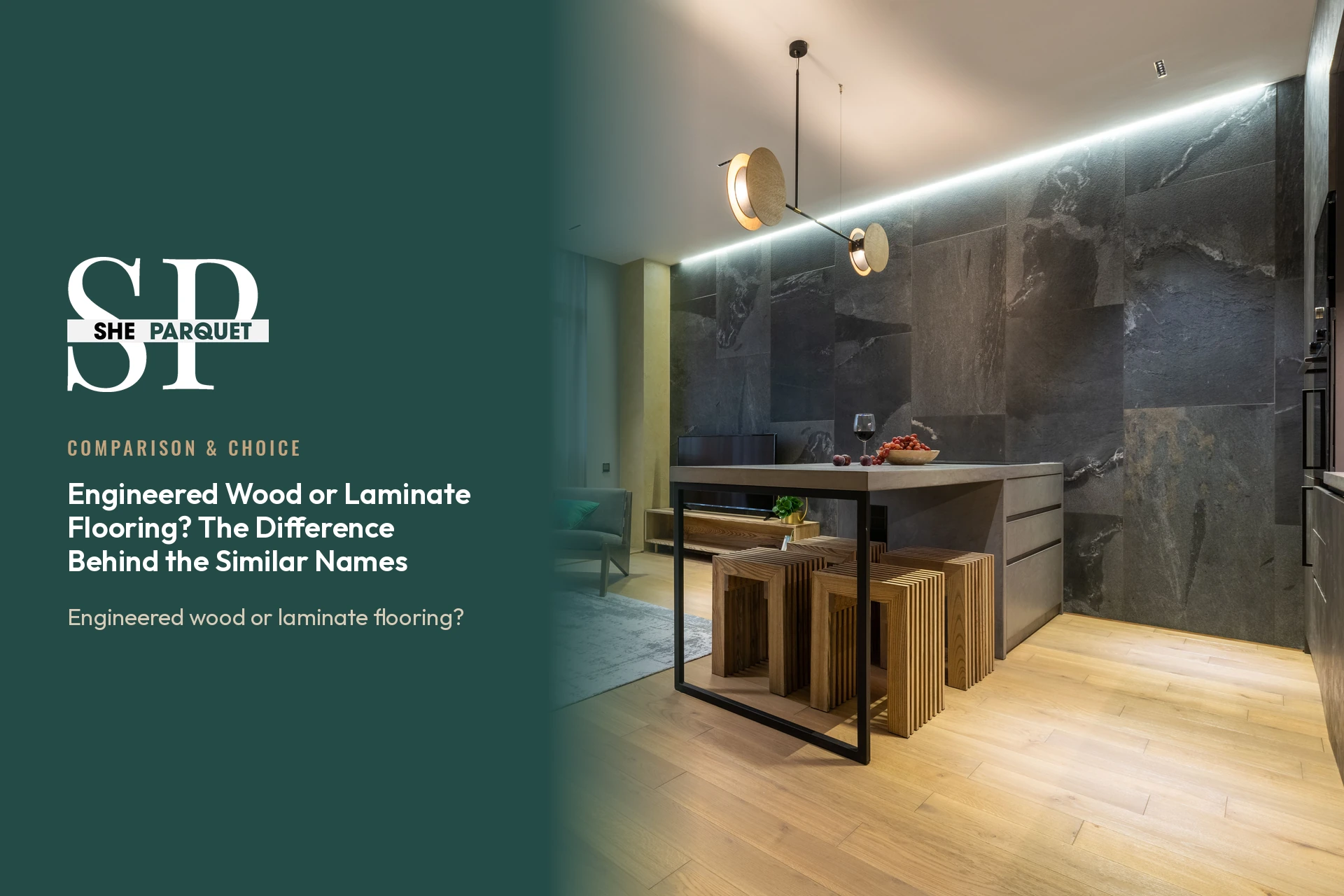
Engineered wood flooring is a multi layer wood floor whose top surface is a genuine sliced wood veneer. Laminate flooring is produced by pressing a wood look decor paper onto a high density fibreboard core and contains no natural wood layer at all. One is wood, the other is wood patterned, and that single difference decides lifespan, repairability and price.
Why the Similar Names Create Confusion
The confusion comes from the fact that both products are built on a layered manufacturing logic and their names sound almost identical in many languages.
The word laminated describes layers bonded together into a single panel. Both engineered wood flooring and laminate flooring share this principle of construction, which is exactly why their names resemble each other. The content of those layers, however, is completely different. The uppermost layer of an engineered board is real timber sliced from oak, walnut or beech, usually between 0.6 mm and 4 mm thick. The top layer of a laminate board is a photographic decor paper protected by a melamine resin wear layer.
In showrooms both products look like wood, so buyers rarely notice the structural distinction. Yet that distinction determines how the floor will behave ten years later. At She Parquet this is the single most frequent question we hear on projects. For readers who want to go deeper, our engineered wood flooring articles and our laminate flooring articles are compiled as separate collections.
Layer Structure: The Internal Anatomy of Both Products
Engineered flooring is a three layer sandwich made of real wood, while laminate is a four layer composite of paper and resin.
In an engineered board a balancing backing sits at the bottom, a cross laid poplar or plywood carrier sits in the middle, and the solid sliced veneer sits on top. Because the grain direction of the layers runs perpendicular from one layer to the next, the panel's tendency to shrink and swell with changing humidity is limited. This is why engineered boards behave more predictably than solid parquet in terms of dimensional stability.
Laminate flooring is layered from bottom to top as balancing paper, HDF core, decor paper and overlay wear layer. The density of the HDF core directly affects product quality, and common thicknesses on the market range from 8 mm to 12 mm. The structure is hard and scratch resistant, but it is not wood. It therefore cannot be sanded, its colour cannot be changed, and deep surface damage cannot be repaired locally. The affected plank simply has to be replaced.
Appearance, Texture and Visual Depth
Engineered flooring carries the grain, knots and colour variation of natural timber exactly as they are, while laminate imitates that look through repeated printing.
On a real wood surface no two planks are identical. As the angle of light changes the grain shifts in brightness, and the surface develops a patina over time. On laminate the same decor paper repeats at fixed intervals. Good manufacturers reduce this effect by increasing the number of different print repeats, and synchronised embossing aligns the texture with the print, yet the difference is still noticeable at close range.
Pattern choice also changes where a floor belongs. Wide and long boards such as our Plank Engineered Parquet options visually enlarge spacious living rooms, while Hungarian Point Engineered Parquet is preferred in classical interiors and character driven areas such as hotel lobbies. For anyone curious about the laminate version of the chevron and herringbone idea, the article Herringbone Laminate Flooring: Elegance and Durability Together offers a comparative view.
How Is Durability and Wear Resistance Measured?
Laminate surface hardness is measured by the AC class, while the life of an engineered floor is measured by veneer thickness and lacquer quality.
For laminate, AC3 is generally recommended for homes, AC4 for heavily used residences and light commercial areas, and AC5 for commercial spaces. This classification summarises resistance to scratching, impact and staining. The melamine wear layer is extremely hard, so laminate can actually cope with everyday scratching better than an engineered board.
With engineered flooring the key criterion is the thickness of the sliced veneer. A 0.6 mm top layer offers aesthetic service life but cannot be sanded. Products with a top layer of 2.5 mm or more can, depending on the installation, be sanded and refinished once or twice. That means the floor can be renewed across more than twenty years of use. In short, laminate is tougher at the surface while engineered wood is repairable over the long term. On She Parquet projects the decision usually comes down to which of these two approaches suits the user better.
Moisture, Wet Areas and Underfloor Heating
Neither product in its standard form is designed for permanently wet areas, but their reactions to moisture differ.
The HDF core of laminate tends to swell when it meets water, and that swelling is irreversible. Even with products that claim water resistance, water seeping through the joints must never be left standing. On engineered flooring the top layer is real wood, so surface water wiped away quickly usually leaves no permanent damage, although water running down between the joints can cause the layers to separate.
In underfloor heating systems engineered flooring is the widely preferred option thanks to its cross layered construction. For both products the industry accepted rules are that the floor surface temperature should not exceed 27 degrees and that screed moisture should fall below roughly 2 percent by weight before installation. Keeping indoor relative humidity between 40 and 60 percent during winter also significantly reduces gapping in either floor.
Cost, Lifespan and Total Cost of Ownership
Laminate requires a lower initial investment per square metre, while engineered flooring can win on total cost thanks to longevity and renewability.
The price gap comes straight from raw materials. In engineered boards the oak veneer, the drying process, the factory lacquer and the quality sorting all push cost upwards. Laminate production is largely industrial, so unit cost is lower and more predictable.
Intended service life should drive the decision. In a rental apartment planned for renovation within five to seven years, an AC4 laminate is a sensible choice. In a home that will be lived in for decades, or on a hotel floor where brand perception matters, engineered flooring stands out for its natural texture and its ability to be refinished. To compare quality criteria among imported options, our Imported Engineered Parquet content is a useful starting point.
Which One Should You Choose for Which Space?
The choice becomes clear within the triangle of traffic intensity, budget horizon and the aesthetic expectation of the space.
In office corridors with heavy foot traffic, educational buildings and short term rentals, a high AC class laminate is a practical solution. Click systems make installation fast, maintenance is simple, and damaged planks can be swapped out. In bedrooms, living rooms, boutique hotels and homes where resale value matters, engineered flooring leads with its natural warmth and repairability.
In both cases success depends far more on installation than on the product itself. Choosing the correct underlay, leaving sufficient expansion gaps around walls, achieving a level subfloor and acclimatising the material to site conditions all define how long the floor lasts. She Parquet evaluates these technical details together with clients on residential and hotel projects, from product selection through to final installation.
Frequently Asked Questions
Are engineered wood flooring and laminate flooring the same thing?
No, they are not. The top surface of engineered flooring is real sliced timber, while the top surface of laminate is a wood look decor paper protected by a melamine wear layer. The similarity in names comes from the layered production method shared by both products.
Which one lasts longer?
Engineered flooring with a top layer of 2.5 mm or more can be sanded and refinished, so with correct care it can serve for more than twenty years. Laminate cannot be renewed and its life is limited by the endurance of the wear layer. Laminate suits short term use, engineered wood wins over the long term.
Which should be used with underfloor heating?
Engineered flooring is widely preferred with underfloor heating because of its cross layered construction. For both products the floor surface temperature should not exceed 27 degrees and screed moisture must drop to an appropriate level before installation.
What does the AC class mean in laminate flooring?
The AC class is a standard measure showing resistance to abrasion, scratching and impact. AC3 is generally sufficient in homes, AC4 is recommended for heavily used areas and AC5 for commercial spaces. The higher the class, the stronger the surface.
Can engineered flooring be used in a kitchen?
Yes, provided spills are wiped up quickly and water never collects in the joints. Placing mats in front of the dishwasher and sink and checking regularly for leaks is advisable. In permanently wet areas, waterproof alternatives are safer.
-
What Determines Parquet Pricing? The Five Components of Square Metre Cost
-
Flooring Selection for Hotels and Commercial Spaces: A Guide by Use Class
-
Which Parquet Resists Dry Air Best? A Dimensional Stability Comparison
-
Which Flooring for a Rental Apartment? Balancing Durability and Cost
-
SPC Flooring or Laminate Flooring? Which Lasts in Wet Areas
-
Which Parquet Suits Underfloor Heating? A Material by Material Comparison
-
Solid Wood or Engineered Parquet? Lifespan, Maintenance and Cost Compared
-
How to Choose Plank Direction When Installing Parquet: Light, Room Shape and the Joint Rule