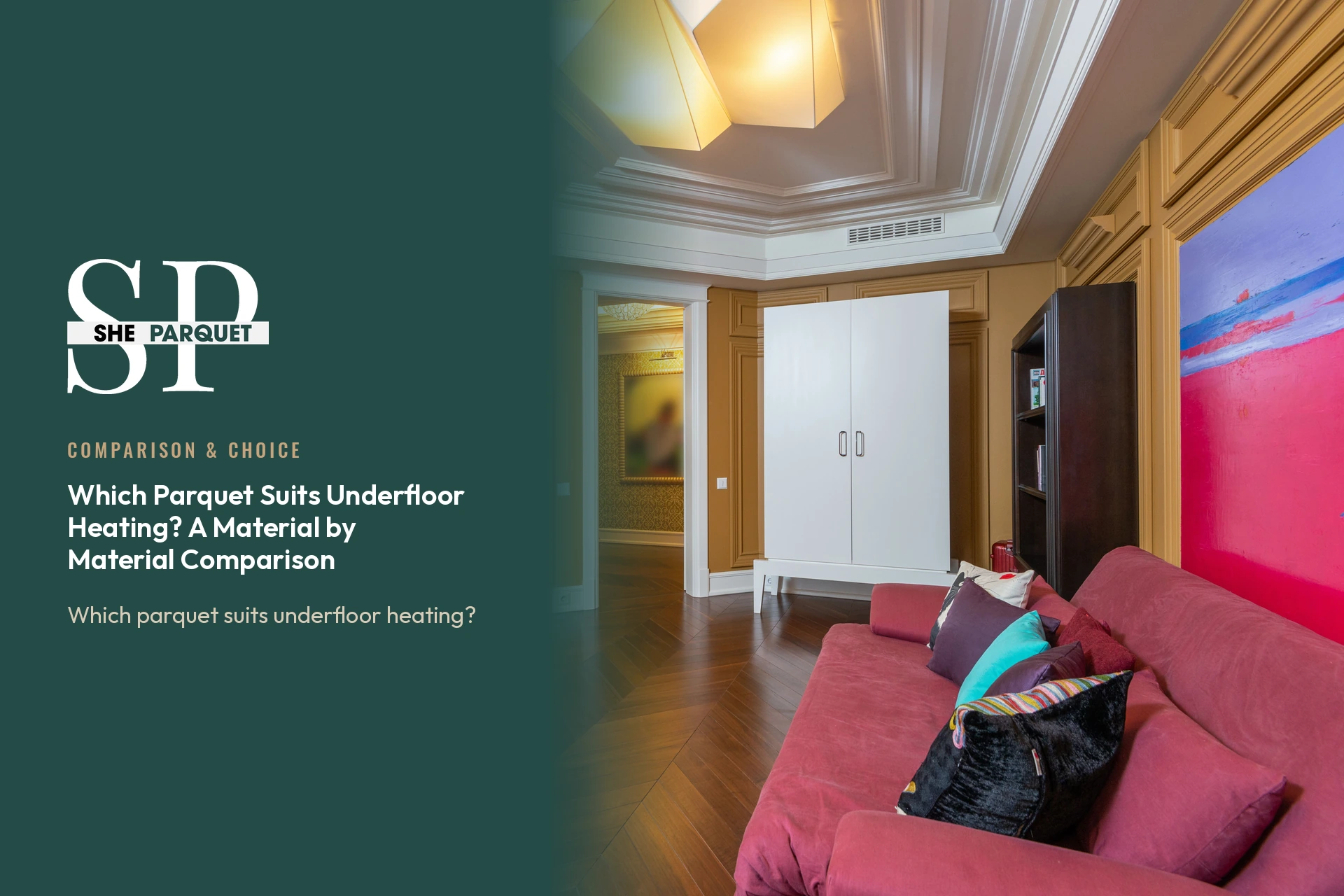
The best choice for underfloor heating is a floor covering with high dimensional stability and low thermal resistance. Thanks to its cross layered construction, engineered parquet meets this requirement in the most balanced way, while SPC flooring is a strong second option because it conducts heat quickly. Thick solid parquet and thick insulating underlays are generally not recommended.
What does underfloor heating expect from a floor covering?
Underfloor heating asks two things from a floor covering: low thermal resistance and dimensional stability against changes in moisture and temperature.
As heat travels from the pipes embedded in the screed up to the surface, the covering and the underlay together form a layer of resistance. The widely accepted rule in the industry is that the combined thermal resistance of covering plus underlay should stay around 0.15 m2K/W or below. When this threshold is exceeded, the system has to run with higher water temperatures to reach the same room temperature, energy consumption rises and temperature fluctuations become noticeable on the surface.
The second expectation is stability. Wood is hygroscopic. It shrinks when ambient humidity falls and expands when humidity rises. In a room with underfloor heating, the floor is constantly warming and cooling, so this movement is greater than normal. That is why production technology, layer structure and thickness become more decisive than decorative appearance. In a standard installation, the surface temperature should not exceed 27 degrees, or 29 degrees in wet areas. This limit protects both the service life of the wood and everyday comfort.
Engineered parquet: the most balanced partner for underfloor heating
Engineered parquet is the safest natural wood option for underfloor heating because of its cross directional layer structure.
In engineered parquet the top layer is real wood, while the supporting layers beneath it are pressed so that the fibres run perpendicular to each other. This construction balances the natural tendency of wood to expand and contract from the inside. As a result, the surface keeps its genuine wood texture while the risk of cupping and open joints seen in solid material is significantly reduced. This is exactly why She Parquet recommends this product group first in residential and hotel projects with underfloor heating.
In practice, thicknesses between 14 mm and 15 mm strike a good balance between heat transfer and mechanical strength. For a spacious look across large areas you can choose plank engineered parquet, while for a more characterful, patterned layout Hungarian point engineered parquet is a strong option. The pattern itself does not change thermal performance. What matters is thickness, bonding method and the underlay. Readers who want to go deeper can browse the content in the engineered parquet articles section.
SPC flooring: fast warming and indifferent to water
SPC flooring is an option that conducts heat quickly and is unaffected by moisture thanks to its mineral filled rigid core.
The body, made of stone powder and polymer, does not show anywhere near the moisture movement of wood. That makes it easy to combine with underfloor heating in wet areas such as bathrooms, kitchens and terrace entrances. Its slim build, typically in the 4 mm to 6 mm band, offers low thermal resistance, so the system reacts in a shorter time. Users who adjust the thermostat often appreciate this fast response.
On the other hand, SPC does not tolerate high surface temperatures indefinitely. Remember that the manufacturer limit is usually a surface temperature of 27 degrees, and extra care is needed in front of large glazed areas exposed to direct sunlight, where additional heat build up can occur. The subfloor must also be perfectly flat, because in areas with voids the locking system can start to make noise over time. To read about the behaviour of the material in detail, the SPC and waterproof flooring articles are a useful starting point.
Laminate flooring: budget friendly with clear limits
Laminate flooring can be used with underfloor heating, but only if the product is explicitly declared suitable for this use.
The core of laminate flooring is HDF, and HDF can swell in a way that is hard to reverse when exposed to moisture. Because underfloor heating pushes residual moisture from the screed towards the surface, moisture testing before installation is even more critical here. For residential use, wear class AC4 is preferred, while AC5 is chosen for heavy traffic areas. Thicknesses between 8 mm and 12 mm are common, and products above 12 mm can slow heat transfer.
With laminate, the real problem is often not the panel itself but the thick foam mat laid beneath it. In underfloor heating installations, thin underlays with low thermal resistance and a clear declaration of heating compatibility must be selected. A vapour barrier film is indispensable. When these details are skipped, a product bought cheaply comes back as a high energy bill.
Solid parquet: natural but risky
Solid parquet is the riskiest option for underfloor heating because of its single piece timber structure.
In one piece wood there is no opposing layer to balance the fibres, so changes in heat and moisture translate directly into expansion and contraction at the surface. At thicknesses of 18 mm and above, thermal resistance also rises and system efficiency drops. In winter months, when relative humidity falls below 35 percent, open joints can become clearly visible.
It cannot be said that solid wood is completely impossible. It can be used with narrow boards, full surface bonding, stable species rather than low density ones, and rooms supported by humidifiers. However, meeting all of these conditions is both costly and operationally difficult. For a detailed look at the balance of service life, maintenance and cost between the two materials, the article solid parquet or engineered parquet: life span, maintenance and cost comparison offers a comparative framework.
Technical thresholds and commissioning before installation
Success on an underfloor heated floor depends less on the material and more on correct subfloor preparation and controlled commissioning.
After the screed is poured, the system is started up gradually according to the manufacturer instructions. Common practice is to raise the water temperature in stages over several days, then lower it the same way, leaving the surface lukewarm on installation day. This process lets the screed release its residual moisture and allows the system to be tested.
Before installation, moisture content is expected to be below 2 percent in cement based screed and lower still in anhydrite screed. Surface flatness should stay within millimetric tolerances measured with a 2 metre straight edge. For wood based products, full surface bonding gives better thermal contact and less noise than floating installation. Expansion gaps must be left along walls, and expansion profiles should be used across large areas. For those considering energy efficiency and material choice together, the article on sustainable materials and smart technologies offers a complementary perspective.
Decision table: which material for which room?
The right choice is made according to the moisture load of the room, the intensity of use and the expected level of visual quality.
- Living room, bedroom, hotel room: Engineered parquet. Natural wood surface, stable core, renewable top layer.
- Kitchen, bathroom, laundry room: SPC flooring. A safe solution where the risk of water contact is high.
- Rental apartments and fast renovation projects: AC4 laminate flooring declared suitable for underfloor heating.
- Classic concept rooms without underfloor heating: Solid parquet.
The most common mistake in practice is choosing a product on price alone and treating the underlay and adhesive as secondary. Yet the same parquet can become an inefficient system with the wrong underlay and an economical one with the right choice. She Parquet evaluates material, underlay and installation method together in project based work, so that visual expectations and thermal performance are met at the same time.
Frequently Asked Questions
Is engineered parquet or SPC flooring better for underfloor heating?
In dry rooms, where a natural wood look and the ability to refinish matter, engineered parquet is better. In wet areas and spaces with a high risk of water, SPC flooring is safer. Both are compatible with underfloor heating, and the decision follows the moisture load of the room.
What thickness should parquet be over underfloor heating?
For engineered parquet, thicknesses between 14 mm and 15 mm are balanced in terms of heat transfer and durability. Laminate flooring is commonly found in the 8 mm to 12 mm band, while SPC is typically 4 mm to 6 mm. As thickness increases, thermal resistance increases too.
What is the maximum surface temperature for underfloor heating?
With wood based coverings, the surface temperature should not exceed 27 degrees, and in wet areas this limit can rise to 29 degrees. Higher temperatures cause excessive drying and open joints in wood. The system thermostat should be limited accordingly.
What screed moisture level is required and when can parquet be laid?
Cement based screed is expected to drop below 2 percent moisture, and anhydrite screed to a lower value. Before installation, the system should be commissioned in stages and then reduced again. Laying the floor without measuring moisture is the most frequent mistake.
Can solid parquet be used with underfloor heating?
It is technically possible but not recommended, because one piece wood moves more in response to changes in heat and moisture. If it is used, choose narrow boards, full surface bonding and rooms where humidity is kept under control. Otherwise the risk of open joints is high.
-
Solid Wood or Engineered Parquet? Lifespan, Maintenance and Cost Compared
-
Why Expansion Gaps Matter: The Real Cause of Buckling and Gapping
-
How to Clean Parquet: 5 Rights and 5 Wrongs in Daily Care
-
Screed Moisture and Subfloor Preparation: 6 Checks Before Laying Parquet
-
Autumn Parquet Care: What Changes Underfoot as Humidity Drops
-
Pre-Winter Parquet Check: A 7 Point Seasonal Checklist
-
Hungarian Laminate Flooring
-
Sustainable Materials and Smart Technologies