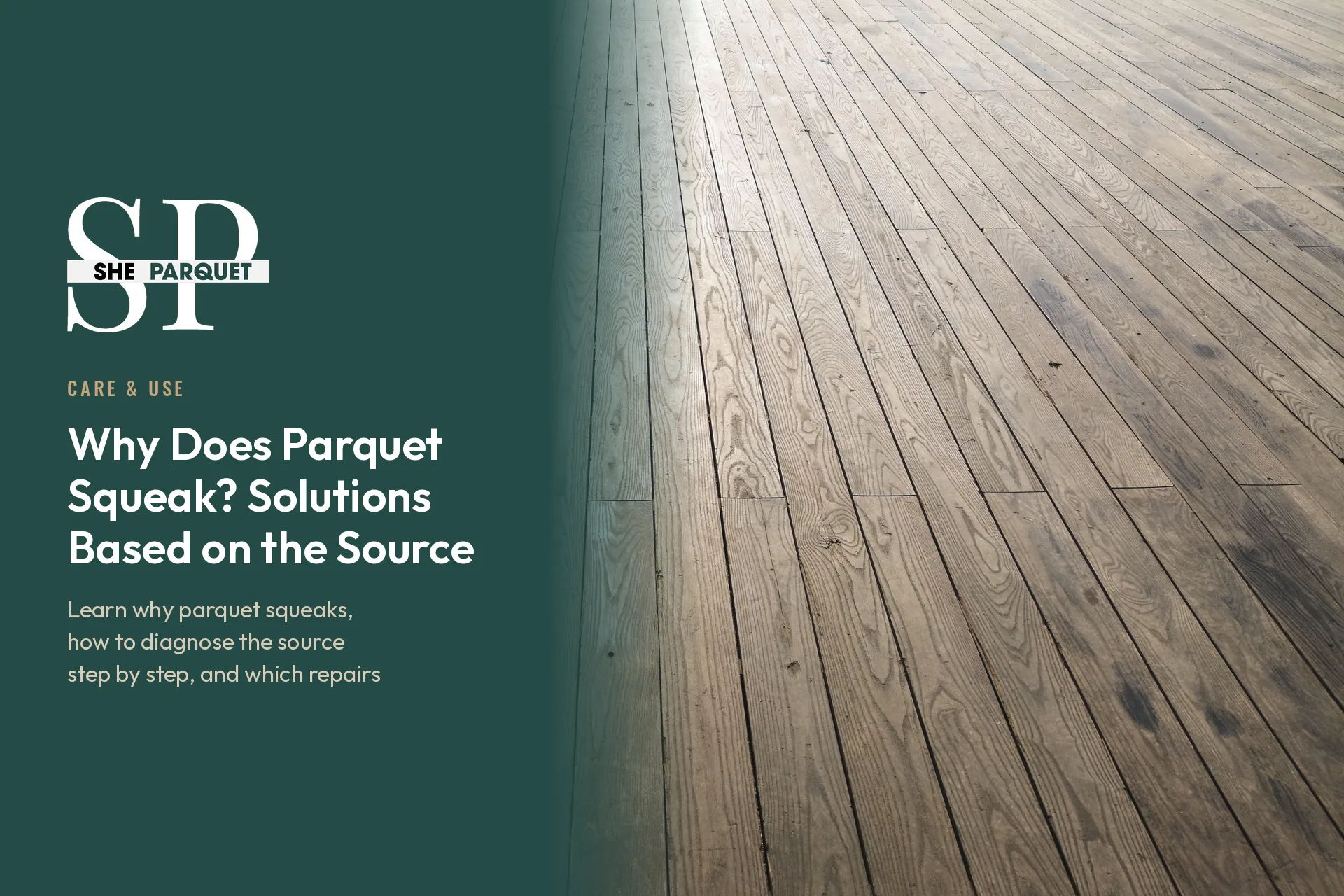
Parquet squeaking is the sound of friction created where the floor covering meets the subfloor or where its own pieces rub together. The most common causes are loosened fasteners, an uneven or sunken screed surface, insufficient expansion gaps, a degraded underlay and boards that shrink with seasonal humidity swings. The cure is to identify the source correctly and intervene at that exact point.
The basic mechanism behind a squeaking floor
A squeak is the audible vibration produced when two surfaces rub against each other. In solid wood flooring this friction usually comes from board edges pressing against one another, from a nail or screw working loose inside the timber, or from the board moving up and down over a void beneath it. Wood is a hygroscopic material, which means it absorbs and releases moisture from the surrounding air. When relative humidity drops during winter the boards shrink, and in summer they expand again. That movement is not a defect in itself. Problems begin where the movement is restricted or, conversely, where it becomes completely free.
Not every sound means the same thing. A dull crack heard underfoot usually points to a void in the substrate, while a thin, high pitched creak indicates board edges rubbing together. Noise concentrated along the walls is normally linked to an expansion gap that has closed. Noting the character and location of the sound is the first step in choosing the right repair method.
Squeaks caused by subfloor preparation and screed
The most frequent cause of squeaking is an uneven surface underneath the parquet. The widely accepted practice in the industry is to correct any deviation greater than 3 mm under a 2 metre straightedge. Dips beyond that tolerance leave an air pocket under the floor, so the board drops and rises with every footstep. That repeated movement both fatigues the fixing and produces noise.
Screed moisture is another critical threshold. For cement based screeds the generally accepted limit is below 2 per cent, and for anhydrite screeds the figure is lower still. Solid parquet laid over a screed that has not dried sufficiently will draw moisture from below, swell, then shrink as it dries, leaving gaps at the joints. With the glue down method, insufficient adhesive coverage, the wrong trowel notch or exceeding the open time all create areas that never bond properly. Those spots usually start making noise within a few months. You can find more detailed assessments of subfloor preparation in our solid parquet articles section.
Humidity, seasons and the expansion gap
When squeaking appears seasonally, it is almost always a sign of a moisture imbalance. The ideal indoor condition for wooden floors is generally accepted as a temperature between 18 and 24 degrees with relative humidity between 40 and 60 per cent. In winter, once the heating comes on, relative humidity can fall to around 25 per cent, which makes the boards shrink and opens gaps along the edges. A board that is suddenly free in that gap shifts under load and squeaks.
The opposite scenario also occurs. If the expansion gap left at the walls is too narrow, parquet that expands in summer presses against the wall, lifts slightly and produces pressure noise across the middle of the room. Common practice is to leave a gap of 10 to 15 mm around the perimeter, and to use intermediate expansion profiles on spans over 8 metres. Door thresholds, column bases and pipe penetrations are the places where this gap is most often forgotten. On underfloor heating systems, keeping the surface temperature below 27 degrees is a decisive rule for preventing the wood from drying out excessively and squeaking as a result.
Step by step diagnosis of a squeaking parquet floor
- Walk the floor slowly during a quiet hour and mark every noisy spot with tape.
- Note whether the sound is a thin creak or a dull crack.
- Press down on the marked spot by hand and check whether there is any downward movement.
- Remove the skirting and look at whether the expansion gap at the wall has closed.
- Measure the relative humidity in the room with a hygrometer and confirm it sits between 40 and 60 per cent.
- Assess how close the noisy areas are to radiators, external doors or windows that create moisture differences.
- If the noise is concentrated in one area assume a void in the substrate, and if it is spread across the whole floor assume a moisture related problem, then seek expert advice.
Practical solutions according to the source
There is no single remedy for every squeak, because the intervention depends on where the sound originates. For noise along the walls, the skirting is removed, the expansion gap is reopened with a saw if needed, and the skirting is refitted to the wall rather than to the parquet. This simple correction eliminates a large share of pressure related sounds.
If there is a void in the substrate, glue down installations can be repaired by drilling fine holes at that point and filling the cavity with injection resin. In nailed solid installations, loose fixings are refastened and the holes are closed with wood filler. For the thin creaks caused by board edges rubbing together, special lubricants or talc based solutions applied into the joint bring temporary relief, but the lasting answer is restoring the moisture balance. Where the noise is widespread over a large area and the underlay beneath the parquet has deteriorated, lifting and relaying is the soundest approach. She Parquet assesses the condition of the existing floor on site and helps you decide correctly between repair and renewal.
The role of material quality and production standards
The most effective precaution against squeaking is starting with the right material. Solid boards that have not spent enough time in the kiln and whose moisture content has not stabilised will change dimension after installation, making noise problems inevitable. For interior use, the moisture content of timber is generally expected to sit between 7 and 11 per cent. Edge machining precision matters just as much, because when tongue and groove tolerances do not match, boards either sit too tightly or stay loose.
Thickness has a direct effect too. Solid parquet is commonly produced between 14 and 22 mm, and as thickness increases the board resists bending better and therefore stays quieter. The article Why You Should Choose Imported Parquet, which explains in detail why production and drying standards matter, is a good starting point when evaluating material choices. Species also makes a difference, since dimensionally stable woods such as oak behave far more predictably through seasonal movement.
A preventive approach to a squeak free floor
Preventing squeaks before installation is always more economical than repairing them afterwards. Parquet packs should be left unopened in the room where they will be installed for at least 48 hours, preferably 72, so they can acclimatise to the ambient conditions. This period lets the boards reach their settled moisture balance and reduces movement after laying. Having the building heating system running during installation gives a realistic balance for winter conditions.
A few habits during daily use are equally decisive. Using a humidifier in winter to keep relative humidity above 40 per cent, leaving ventilation space in front of radiators, fitting felt pads to heavy furniture legs and avoiding excessively wet mopping all reduce noise problems over the long term. For anyone planning the right floor concept at residential scale, the article Perfect Flooring Solutions for Residential Projects: She Parquet's Innovative Designs offers useful guidance. She Parquet handles both the material and the installation side together in residential and hotel projects, aiming for quiet floors that last.
Frequently Asked Questions
Why does newly installed parquet squeak?
In new floors, squeaking usually stems from inadequate levelling, a screed that has not dried, or parquet that was not acclimatised long enough. An acclimatisation period of 48 to 72 hours before installation and a screed moisture level below 2 per cent reduce this risk substantially. If the problem appears in the first few months, contact the company that carried out the installation.
Does parquet squeaking go away on its own?
Only seasonal squeaks caused purely by moisture imbalance may fade or disappear once relative humidity returns to the 40 to 60 per cent range. Mechanical causes such as a void in the substrate, a loosened fixing or a closed expansion gap will not correct themselves. Observing how the noise relates to the season is the most practical route to a correct diagnosis.
Can a squeaking floor be repaired without lifting it?
Yes, in many cases it can. Reopening the expansion gap at the wall, injecting resin into voids underneath and refastening loose fixings are all methods that require no removal. However, if the noise is spread across a wide area and the substrate has deteriorated generally, partial or full renewal gives a more permanent result.
What should be done about squeaking that increases in winter?
Heating lowers relative humidity in winter, so the wood shrinks and noise increases. Monitoring humidity with a hygrometer and using a humidifier to hold the 40 to 60 per cent range is the most effective measure. On underfloor heating, keeping the surface temperature below 27 degrees also prevents the wood from drying out excessively.
Which type of parquet squeaks less?
Engineered parquet with a multi layer, dimensionally stable structure reacts less to seasonal movement than solid wood, so it generally stays quieter. With solid parquet, stable species such as oak, properly dried boards and thicknesses above 14 mm reduce the risk of noise. In every case, subfloor preparation and installation quality remain the decisive factors.
-
How a Doormat Saves Your Parquet: Winter Grit and Road Salt

-
Does a Humidifier Protect Parquet? Correct Winter Use
-
What Should Indoor Humidity Be in Winter? The Range That Protects Your Parquet
-
Why Do Gaps Open Between Floorboards When the Heating Comes On?
-
Water Spilled on Your Floor? What to Do in the First 30 Minutes
-
How to Clean Parquet: 5 Rights and 5 Wrongs in Daily Care
-
Autumn Parquet Care: What Changes Underfoot as Humidity Drops
-
How to Choose Plank Direction When Installing Parquet: Light, Room Shape and the Joint Rule