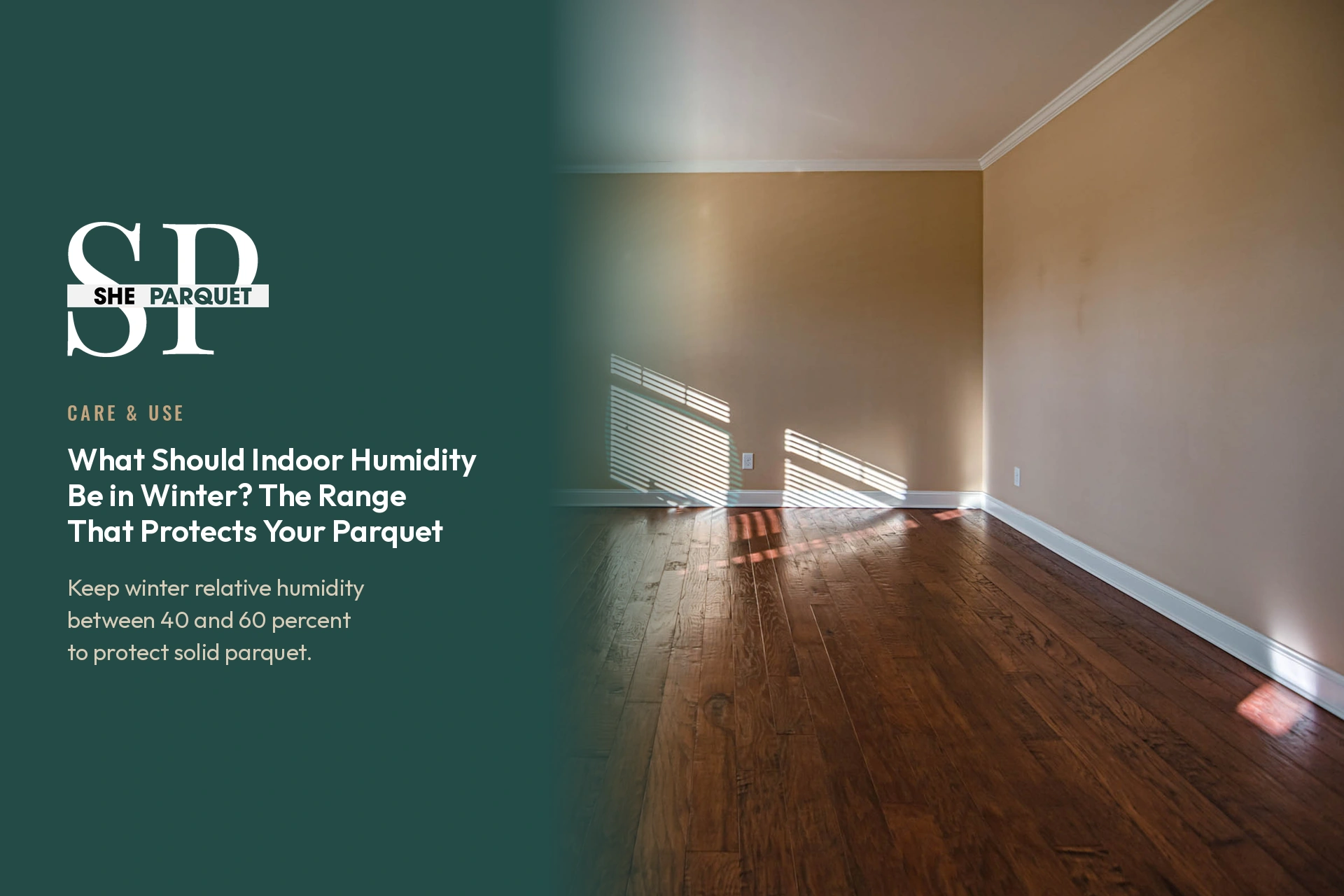
The ideal relative humidity range for wood floors in winter is 40 to 60 percent, and within this band solid parquet holds its own equilibrium moisture content at roughly 7 to 9 percent. When humidity falls below 35 percent, gaps open along board edges. Above 65 percent, cupping and edge swelling become a clear risk.
Why winter humidity should stay between 40 and 60 percent
Because wood is a hygroscopic material that constantly absorbs and releases moisture in response to the air around it.
Solid parquet keeps breathing long after the tree has been cut. When relative humidity in the room drops, the water inside the board evaporates, cell walls contract and the plank shrinks across its width. When humidity rises, the opposite happens. This movement is not a defect, it is the natural behaviour of the material. The problem only starts when the movement becomes sudden and uncontrolled.
The 40 to 60 percent band is the widely accepted safe range in the industry because within it the equilibrium moisture content of wood settles at around 7 to 9 percent. During manufacturing, parquet boards are also dried with that same equilibrium target in mind. Keeping your floor inside this band therefore means keeping the material as close as possible to the condition it left the factory in.
The same range suits human health. Very dry air irritates the respiratory tract, very humid air invites mould. The humidity level that protects parquet is in fact the level that raises living comfort. In the residential and hotel projects completed by She Parquet, the first recommendation handed to the end user after delivery is usually to maintain this humidity band.
What exactly happens to solid parquet when humidity drops
As humidity falls, boards narrow and fine gaps open between them.
When boilers and radiators come on in winter, indoor air warms up, the heated air spreads the same amount of water through a larger volume and relative humidity falls quickly. If it is zero degrees and 80 percent humidity outside, the same air heated to 22 degrees can drop to 25 or 30 percent relative humidity indoors. That is a far drier climate than the one your floor has been living with for months.
The result is gaps along board edges that start out as thin as a hair and can reach 1 to 2 millimetres over time. On wide solid boards the movement is more visible than on narrow ones, because shrinkage is proportional to width. In some cases you may also see slight cupping across the surface or hear faint creaking at board ends.
One point matters above all: most of the gaps that open during winter close again on their own in spring, when humidity rises. Panicking and applying filler or putty usually causes permanent damage. The correct approach is not to close the gap but to bring the humidity back into balance.
Measuring humidity correctly with a hygrometer
Humidity management is done with measurement, not guesswork.
A digital hygrometer is the cheapest and most effective tool for the job. Do not place it against an external wall, on top of a radiator or in direct sunlight. Putting it on a shelf near the middle of the room, 1.2 to 1.5 metres above the floor, gives a far more realistic reading. In large apartments it helps to use two separate devices, one for the living room and one for the bedroom, because the difference between rooms can reach 10 percent.
Record one reading a day, preferably in the evening. A single measurement means little, the weekly trend is what counts. If humidity stays below 35 percent for three days in a row, you need to intervene. Equally, continuous readings above 65 percent can point to a structural moisture problem, especially in ground floor flats or units above a basement.
On a floor that is about to be installed, measurement is not limited to air humidity. Screed moisture must be below 2 percent before installation, which is the accepted threshold for cement based screeds, and that value is checked with a CM device.
Balancing winter humidity step by step
- Place the hygrometer near the centre of the room, 1.2 to 1.5 metres above the floor, and take a daily reading.
- Keep room temperature steady between 20 and 22 degrees and avoid overheating.
- When humidity falls below 40 percent, switch on an evaporative or ultrasonic humidifier.
- Never put the humidifier on the parquet. Keep it at least 1 metre away and raise it onto a side table.
- Ventilate twice a day with short cross ventilation of 5 to 10 minutes rather than leaving windows open for hours.
- Hang water containers on radiators or add broad leaved plants for natural humidity support.
- When humidity passes 60 percent, turn the humidifier off and run kitchen and bathroom extractors regularly.
Choosing a humidifier and the common mistakes
The right device is one sized for the room volume that stops automatically through a humidity sensor.
Ultrasonic humidifiers are quiet and use little energy, but with hard water they leave a white limescale dust on furniture and flooring. Evaporative models avoid that problem yet consume more electricity. Whichever type you choose, weekly cleaning and water changes are essential, otherwise the device spreads bacteria instead of moisture.
The most frequent mistake is placing the unit directly on the parquet. Condensing vapour causes local swelling on the board surface. The second mistake is trying to balance a whole home with one large device, since moisture does not travel from room to room while doors are closed. The third is leaving the device running all night without a hygrometer and unknowingly creating a 70 percent humidity environment.
Moisture sensitivity also varies by floor type. Solid parquet is the most sensitive group, while engineered parquet is more stable thanks to its multi layer structure. For material comparisons you can browse the solid parquet articles, and if you are considering an alternative, the guide on how to choose laminate flooring is a useful starting point.
How underfloor heating and radiators affect humidity
The heating system is the single strongest factor shaping relative humidity through the winter.
In rooms with underfloor heating, the general rule is that the parquet surface temperature should not exceed 27 degrees. Beyond that limit the underside of the wood dries faster than the top, tension builds between the layers and cupping begins. Instead of switching the system on at full output at the start of winter, raise it gradually over several days so the boards can adapt.
With radiators the issue is different. The column of hot air rising around a radiator lowers relative humidity in that zone noticeably compared with the rest of the room. That is why boards next to radiators tend to show wider gaps. Water containers placed under the radiator and a 15 to 20 centimetre air gap when positioning furniture reduce this difference.
In both systems the expansion gap along the walls must be covered by skirting but never blocked. That gap, left at 10 to 15 millimetres depending on floor width, quietly absorbs the movement of the wood between winter and summer.
A maintenance calendar for the winter months
Humidity balance is not a one off adjustment, it is a small routine that runs through the season.
Start in early November by installing the hygrometer and taking your first readings. Through December and January, log humidity once a week, clean the humidifier filter and mop with a barely damp cloth rather than a wet one. A wet mop pushes water between the boards even in dry air and reverses the moisture problem locally.
In February, visually check the risk points such as door thresholds, window areas and the zones around radiators. Gaps under 1 millimetre are normal and will close with spring humidity. In March, reduce heating gradually, switch the humidifier off and increase ventilation frequency.
Surface care needs extra attention in winter too. On oiled solid parquet, refreshing the maintenance oil at the start of the season slows the moisture that dry air pulls from the surface. On lacquered surfaces a pH neutral cleaner is enough. If permanent gapping, cupping or audible movement continues, the right step is to request an on site assessment with your measurements in hand from an experienced installation team such as She Parquet.
Frequently Asked Questions
What should indoor relative humidity be in winter?
For solid parquet the ideal range is 40 to 60 percent relative humidity. Within that band the equilibrium moisture content of the wood stays around 7 to 9 percent and shrinkage movement is minimised. Values below 35 percent and above 65 percent are considered risky.
Are the gaps that open between boards in winter permanent?
In most cases they are not. Gaps under 1 millimetre caused by dry air largely close again in spring when humidity rises. For that reason applying putty or filler in midwinter is not recommended, you should wait through one full season first.
Can I place a humidifier on the parquet?
No, the device should never sit directly on the floor. Condensing vapour can cause local swelling and staining on the board surface. Keep the humidifier at least 1 metre away from the parquet, raise it onto a side table and place a waterproof tray underneath.
What surface temperature is safe for parquet over underfloor heating?
The general rule is that the parquet surface temperature should not exceed 27 degrees. Above that limit the wood dries quickly, tension builds between the layers and the risk of cupping increases. The system should be brought up gradually over several days rather than all at once.
Does ventilating lower humidity even further?
Long ventilation does lower relative humidity in winter, because cold outdoor air becomes dry once it warms up indoors. That is why short cross ventilation of 5 to 10 minutes twice a day is preferable. This is enough for air quality and does not upset the moisture balance.
-
Why Do Gaps Open Between Floorboards When the Heating Comes On?
-
Water Spilled on Your Floor? What to Do in the First 30 Minutes
-
How to Clean Parquet: 5 Rights and 5 Wrongs in Daily Care
-
Autumn Parquet Care: What Changes Underfoot as Humidity Drops
-
Parquet Installation Methods: Click, Glue Down and Nail Down
-
Which Parquet Resists Dry Air Best? A Dimensional Stability Comparison
-
Wood Flooring Over Underfloor Heating: Surface Temperature and Thickness
-
Which Flooring for a Rental Apartment? Balancing Durability and Cost